Corporate tax in Cyprus 2026: from 12.5 to 15 per cent — what really changes
Corporate tax rise to 15 per cent from 1 January 2026, implementation of OECD Pillar Two, effects on holding structures and Cypriot property Ltd. companies for DACH investors.
Increase to 15 per cent from 1 January 2026, OECD Pillar Two, effects on holding structures and the non-dom set-up. As of April 2026. Legal basis: Income Tax Law N.118(I)/2002, OECD Pillar Two implementation rules (EU Directive 2022/2523), Cyprus Global Minimum Tax Law 2024. Practical information: Cyprus Tax Department, PwC Cyprus Tax Facts 2026, KPMG Cyprus Corporate Tax Guide 2026. We are not tax advisers. Before deciding on a structure, speak to a Cypriot CPA or lawyer.
What changed in 2026
On 1 January 2026 Cyprus raised its corporate income tax (in German: Körperschaftsteuer, KöSt) from 12.5 to 15 per cent. The new rate is aligned with the OECD global minimum tax rate (Pillar Two), which the EU cast into law through Directive 2022/2523. Cyprus introduced the increase across the board, including below the Pillar Two threshold (EUR 750 million in revenue), in order to avoid a two-track system and to minimise the locational disadvantage for small companies.
This article explains what this means in practice for you as a DACH entrepreneur or property investor with a Cypriot Ltd., how corporate tax fits into the overall tax calculation and when the Ltd. structure still pays off.

The key parameters of Cypriot corporate tax in 2026
- Rate: 15 per cent flat on company profits (previously 12.5 per cent until 31 December 2025)
- Tax base: worldwide income of Cypriot tax-resident companies (registered office or management and control in Cyprus)
- Legal forms covered: Ltd. (private company limited by shares), PLC, LP, branches of foreign companies operating in Cyprus
- Tax period: calendar year or financial year
- Advance payments: two instalments per year (31 July and 31 December) based on the estimated tax for the year
- Final return: 31 March of the year after next, with the annual financial statements
What the increase costs in concrete terms
The increase of 2.5 percentage points sounds small, but in absolute figures it is noticeable, depending on the level of profit:
| Profit | Corporate tax before (12.5 per cent) | Corporate tax now (15 per cent) | Additional burden |
|---|---|---|---|
| EUR 100,000 | EUR 12,500 | EUR 15,000 | EUR 2,500 |
| EUR 500,000 | EUR 62,500 | EUR 75,000 | EUR 12,500 |
| EUR 2,000,000 | EUR 250,000 | EUR 300,000 | EUR 50,000 |
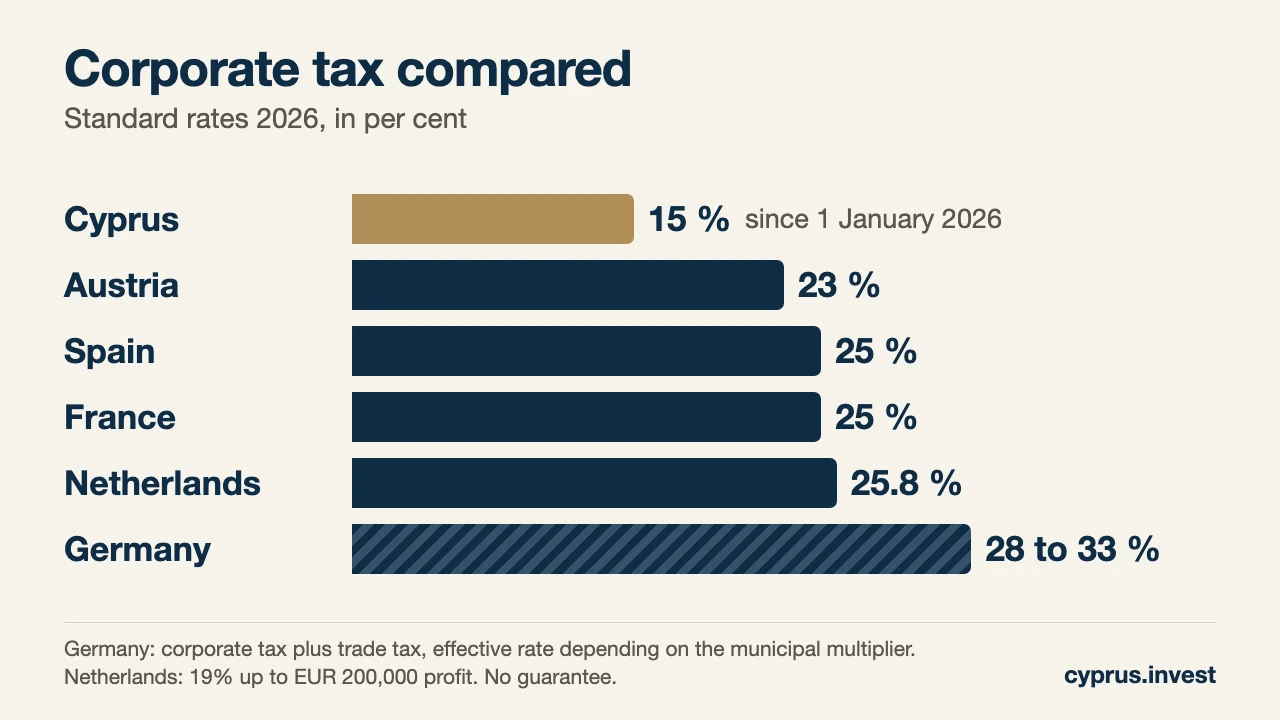
By international comparison, even at 15 per cent Cyprus remains below the level of Germany (corporate tax of 15 per cent plus trade tax, effectively 28 to 33 per cent depending on the municipal multiplier), Austria (23 per cent from 2024), Spain (25 per cent standard), France (25 per cent standard) and the Netherlands (25.8 per cent standard, 19 per cent up to EUR 200,000 profit).
What has stayed the same despite the increase
- Non-dom status: For shareholders, still 0 per cent SDC on dividends and 0 per cent on interest for 17 years. Since 2026 rental income has been free of SDC for all taxpayers, not just non-doms. See the tax guide.
- Notional Interest Deduction (NID): up to 80 per cent deduction on the notional interest on newly contributed equity, effectively reducing corporate tax for equity-financed companies
- IP box regime: up to 80 per cent deduction on net profits from qualifying IP rights, effectively 2.5 per cent on qualifying IP income before the increase, around 3 per cent after it
- Double taxation treaties: Cyprus has more than 65 DTTs, including with Germany, Austria, Switzerland, Russia, Ukraine, India and China
- Dividend distributions to Cypriot holding companies: tax-free (EU Parent-Subsidiary Directive and national rules)
- Trade tax: does not exist in Cyprus; corporate tax is the only level of company taxation
- Loss carry-forward: possible for 7 years (extended from 5 to 7 years by the 2026 reform). No separate minimum tax for small limited companies.
Corporate tax and the property Ltd.
Many DACH buyers set up a Cypriot Ltd. for the property purchase in order to limit liability and to act more flexibly for tax purposes. The mechanics:
Rental income in the Ltd.
- Gross rents less all operating costs (management, maintenance, insurance, interest, depreciation) give the taxable profit
- Depreciation (capital allowance): 3 per cent per year straight-line on the building portion (assumed to be 70 per cent of the purchase price), which for a EUR 500,000 property gives around EUR 10,500 per year in tax-reducing allowances
- Interest deduction: fully deductible in the case of debt financing; the earnings-stripping rule under ATAD limits it to 30 per cent of EBITDA
- 15 per cent corporate tax on the remaining profit
- Distribution as a dividend to non-dom shareholders: 0 per cent SDC, 2.65 per cent GeSY (assessment base of no more than EUR 180,000 per year)
Capital appreciation and sale (capital gains)
- Direct sale of Cypriot property: 20 per cent CGT on the gain (not on a book sale of the shares, but on the asset sale)
- The sale of shares in a Cypriot property Ltd. is usually subject to CGT (20 per cent) if the Ltd. essentially holds Cypriot property
- Allowances (EUR 150,000 for own use, EUR 30,000 for investment) apply to natural persons and for life, not to the Ltd.
Worked example: EUR 500,000 property in the Ltd., long-term let
- Gross rent: EUR 30,000 per year
- Running costs (management, insurance, maintenance): EUR 5,000
- Capital allowance of 3 per cent on the EUR 350,000 building portion: EUR 10,500
- Taxable profit: EUR 14,500
- Corporate tax at 15 per cent: EUR 2,175
- Profit after corporate tax: EUR 12,325
- Distributable as a dividend to the non-dom shareholder: EUR 12,325 (in practice often more out of cash flow, because depreciation is a non-cash item)
- GeSY at 2.65 per cent on the dividend: EUR 327
- Total tax burden (corporate tax plus GeSY): EUR 2,502 on EUR 30,000 of gross rent, i.e. around 8.3 per cent
For comparison: the same property held as a private individual in Germany with a marginal tax rate of 42 per cent comes, after depreciation (AfA) and income-related expenses, to a total burden of around 34 per cent of the gross rent including the solidarity surcharge. The gap to the Cypriot Ltd. structure is around 25 percentage points.
When the Ltd. pays off despite 15 per cent
Ltd. clearly advantageous
- More than two properties or combined business activity (consultancy, services, letting)
- Rental income above EUR 30,000 per year
- Tax deferral through retention of profits is planned (reinvestment without distribution)
- Holding structure with further shareholdings in the EU or third countries
- Short-term letting with turnover subject to VAT (using the input VAT deduction)
Private ownership often simpler and hardly any worse
- A single property with rental income below EUR 30,000 per year
- Annual income (including rent) below around EUR 32,000 in total, because the basic allowance of EUR 22,000 (since 2026) counts in full
- Long-term own use is planned; the Ltd. would be overhead without benefit
- Avoiding ongoing audit costs (audit mandatory above certain thresholds)
Setting up the Ltd. in practice
Formation
- Formation costs with a Cypriot CPA: EUR 1,500 to 3,000
- Minimum capital: EUR 1,000 (symbolic, no real obligation to pay in for a private limited company)
- Duration: one to three weeks
- Registered office and secretary are mandatory, provided by a CPA or corporate service provider (EUR 800 to 2,500 annually)
- At least one director, who may be a foreigner. A Cypriot majority is better, in order to demonstrate management and control in Cyprus.
Running costs
| Item | Annual cost |
|---|---|
| Bookkeeping (small property Ltd.) | EUR 1,500 to 4,000 |
| Audit (mandatory from EUR 200,000 turnover or certain balance sheet thresholds) | EUR 1,500 to 5,000 |
| Annual levy (Registrar of Companies) | EUR 0 (abolished from 2024) |
| Secretary and registered office | EUR 800 to 2,500 |
| VAT registration and quarterly returns (if liable to VAT) | EUR 500 to 1,500 |
| Total | EUR 4,300 to 13,000 |
Below that it is rarely done properly.
Pillar Two: what applies to large groups
Since 2024, Directive 2022/2523 implementing OECD Pillar Two has applied in the EU. Groups with worldwide revenue above EUR 750 million must ensure an effective tax burden of at least 15 per cent in every jurisdiction. Cyprus has introduced its own Qualified Domestic Minimum Top-Up Tax (QDMTT) for this purpose.
For you as a DACH buyer with a small property Ltd. this is irrelevant. You fall far below the 750 million threshold. The relevance of Pillar Two is that the increase in general corporate tax to 15 per cent is a consequence of it, because Cyprus wanted consistency between the taxation of multinational enterprises (MNEs) and standard taxation.
Deciding on a structure: six questions
Whether a Cypriot Ltd. is worthwhile depends heavily on your profile. These six questions help you with a preliminary assessment:
- How many properties are you planning within 5 years? (from two to three: Ltd. makes sense)
- Do you want to retain profits or distribute them? (retention: Ltd. strong; distribution: private ownership often comparable)
- Is your marginal tax rate in Germany high? (42 per cent and more: the Ltd. pays off sooner)
- Will you become a non-dom resident? (yes: the Ltd. delivers its full benefit; no: many advantages fall away)
- Are you planning short-term or long-term letting? (short-term with VAT favours the Ltd.)
- Do you want to limit liability? (yes: Ltd., or private individual with insurance)
Anyone who answers yes to three or more questions should seriously examine the Ltd. option. Anyone who answers yes to only one or two is usually better served by private ownership.
Summary
The corporate tax increase to 15 per cent on 1 January 2026 does make Cyprus somewhat more expensive than before, but by EU comparison the location remains clearly attractive. The combination of low corporate tax, non-dom status at shareholder level and numerous bilateral DTTs continues to make the Cypriot Ltd. one of the most efficient structuring instruments in the EU for DACH entrepreneurs and property investors.
The structural decision (Ltd. or private) does not hinge on the corporate tax rate alone but on the overall picture: number of properties, rental income, marginal tax rate in Germany, non-dom status, short-term or long-term letting, retention or distribution. Anyone who has all of that clearly on the table makes the decision in one meeting with a Cypriot CPA and a German tax adviser.
Sources and further links
- Cyprus Tax Department — Income Tax Law N.118(I)/2002, corporate tax increase 2026
- EU Directive 2022/2523 — OECD Pillar Two, global minimum tax
- Cyprus Global Minimum Tax Law 2024 — QDMTT implementation in Cyprus
- KPMG Cyprus: Tax Alerts — ongoing notes on tax changes
- PwC Cyprus Tax Facts 2026 — advisory practice and case examples
- Cyprus Registrar of Companies — Ltd. formation, compliance, Gazette publications
- Anti-Tax Avoidance Directive (ATAD) — earnings-stripping rule and CFC rules