Construction quality in Cyprus: what really counts and what to look out for
Energy efficiency, materials, defects: how to assess the construction quality of a new-build project in Cyprus. Premium vs. standard explained in concrete terms, with brands.
Energy efficiency, sound insulation, building materials, defect management: how to assess the construction quality of a project in Cyprus before you sign. As of April 2026. Sources: Building and Construction Law, Energy Performance of Buildings in Cyprus (EU Directive 2010/31 as transposed into national law), Cyprus Technical Chamber (ETEK), Cyprus Scientific and Technical Chamber, and experience from conversations with residents and site visits at 34 projects in Paphos, Limassol and Larnaca between 2022 and 2026.
What construction quality in Cyprus really means
Every Cypriot sales brochure today says "luxury" or "premium". On the property market the word has almost completely lost its meaning. It says nothing about construction method, materials, energy standard or durability. This article looks behind the word. It shows you what distinguishes Cypriot construction quality from German, which climatic requirements play a role in the construction method, which materials and standards really mean premium level, and how to recognise the difference between real and supposed quality in brochures and on site visits.
Anyone who buys in Cyprus is buying into a different climate from Germany's. Intense heat, UV radiation, salty air, occasional earthquakes, damp winters. A good property in Cyprus is not simply a German property with more pool. It is a different product, and the construction method has to reflect that.
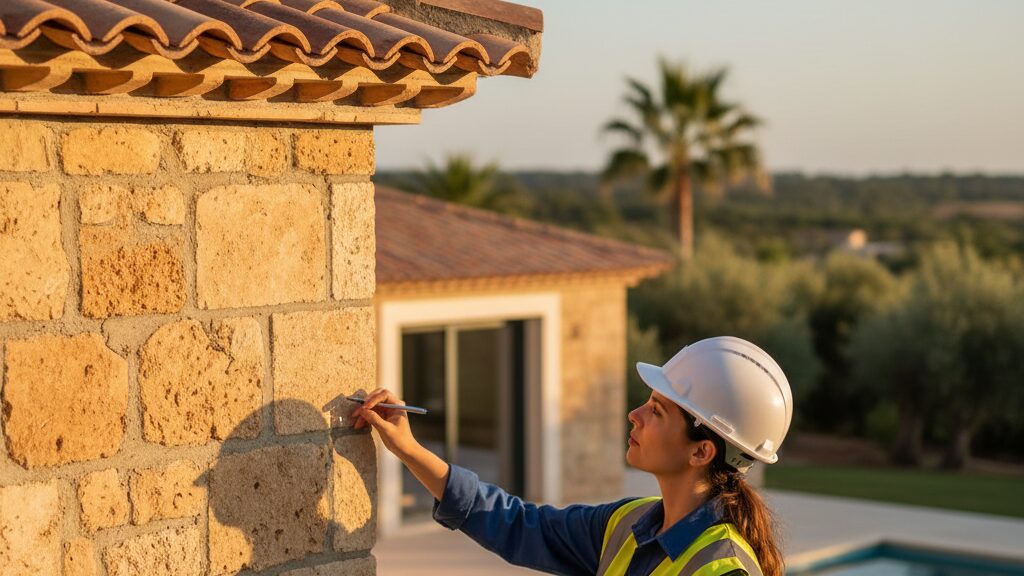
The Cypriot climate as a construction requirement
Four climatic factors determine what a property in Cyprus has to deliver:
Heat and UV radiation
- Average summer daytime temperatures of 28 to 35 degrees, peaks above 40 degrees
- 3,300 hours of sunshine per year, about 80 per cent more than in Germany
- High UV exposure (UV index of 10 and more in summer)
- Consequences: severe ageing of plastics, seals and paints; fading and embrittlement on unprotected surfaces
Salty air in coastal locations
- Chloride content of the air in coastal locations 5 to 10 times higher than inland
- Corrosion of metal (railings, fittings, taps, outdoor air-conditioning units)
- Increased wear on windows and doors
- Consequences: need for rust-proof materials (A4/316 stainless steel, anodised aluminium), regular maintenance
Earthquake zone
- Cyprus lies in a medium seismic risk zone (zone 3 under EC8), lower than Greece or Turkey but higher than Germany
- Historical magnitudes of up to 6.5 on the Richter scale, most recently a magnitude 5.4 quake off Paphos in 2022
- Consequences: developers must build to be earthquake-resistant, with reinforcement in accordance with EC8
Damp winters with heavy rain
- Rain falls almost exclusively from November to March, but intensively
- Humidity is high in winter; poor insulation leads to condensation and mould
- Consequences: requirements for thermal insulation, vapour barrier, water drainage and waterproofing
What counts in the structural shell
Concrete and reinforcement
- Cypriot developers typically use C25/30 concrete (as in standard German buildings)
- Premium construction: C30/37 or higher, with strict quality control
- Reinforcing steel to EN 10080, minimum diameters and spacing in accordance with Eurocode 2 and EC8
- Warning sign: ready-mixed concrete from unknown plants without a works certificate, visible cracks in existing buildings
Masonry and walls
- Standard: brick or aerated concrete with external insulation (external thermal insulation composite system)
- Premium: double-leaf construction with cavity insulation, better sound insulation, better thermal mass
- A Cypriot peculiarity: concrete frame construction with infill; the frame structure is earthquake-resistant, and the infill has to be properly insulated
- Warning sign: thin external walls under 20 cm in total thickness with no insulation; poor indoor air quality in summer
Thermal insulation
- Minimum standard since 2020: energy class A or B mandatory (Implementation Decree 119/2020)
- Premium: values close to passive-house standard, insulation of the building envelope of more than 12 cm, high-quality insulating materials (mineral wool instead of standard EPS)
- Roof area: particularly critical because of solar radiation; high-quality insulation 16 to 20 cm thick recommended
- Warning sign: standard EPS boards under 8 cm thick as the only insulating material, no roof insulation
Windows and glazing
- Standard: aluminium frames with a thermal break, double glazing
- Premium: triple glazing, Ug value below 1.0 W/m²K, external sun protection (electric roller shutters, louvres)
- Critical: quality of the glazing against UV and heat; a solar factor (g-value) below 0.3 is ideal on sun-facing sides
- Warning sign: thin frames without a thermal break, single glazing, visible gaps at the frames
Roof and waterproofing
- Flat roof with gravel or tiled surface is standard; villas also have roof terraces
- Premium: multi-layer waterproofing with root barrier membrane, EPDM membrane or high-quality bituminous sheeting
- Water drainage with clear falls, multiple outlets and emergency overflows
- Warning sign: simple bitumen waterproofing, no root protection on green roofs, roof surfaces that are level or slope the wrong way
What counts in the fit-out
Air conditioning
- Inverter air-conditioning units in every room are standard; energy class A++ or higher for premium
- Central VRF (variable refrigerant flow) systems in upmarket villas
- Premium: underfloor heating combined with air conditioning for winter temperature control
- Warning sign: only one split air-conditioning unit in the living room, no pre-installation in bedrooms, no-name brands without local service
Sanitary ware and taps
- Standard: mid-range brands (Roca, Grohe Bauhaus, Hansgrohe Essence)
- Premium: Hansgrohe Metris, Dornbracht, Grohe SmartControl, Duravit, Villeroy und Boch
- Taps and fittings on the coast must be salt-resistant (A4/316 stainless steel, not A2/304)
- Warning sign: no-name taps, plastic housings, visibly cheap washbasins and toilets
Tiles and floor coverings
- Standard: porcelain stoneware from Italy or Spain, 60x60 cm, slip-resistant
- Premium: large format 80x80 or 120x120 cm, matt surfaces, natural stone (limestone, marble, travertine)
- Wood-effect porcelain stoneware has become standard; real parquet is risky in the Mediterranean climate because moisture makes the wood move
- Warning sign: small 30x30 tiles, irregular joints, cheap imitations
Kitchen
- Standard: local Cypriot or Turkish kitchen makers, laminated fronts, granite worktop (3 cm)
- Premium: German kitchens (Nobilia, Leicht, Beckermann), quartz or solid wood worktops, branded appliances (Miele, Bosch, Siemens)
- A motorised extractor hood venting through the roof is mandatory in enclosed kitchens
- Warning sign: simple chipboard fronts, thin 2 cm worktops without edge protection, local no-name appliances
Electrics and smart home
- Standard: sufficient sockets (at least six per room), LAN cabling in all rooms
- Premium: KNX or Loxone as the smart-home standard, automated shading, lighting scenes, audio integration
- Security system: alarm system with window contacts, video door intercom, surveillance cameras
- Warning sign: no structured cabling, few sockets, visible surface-mounted installation after completion
Pool and outdoor areas
- Pool construction: Gunite (sprayed concrete) with tile or epoxy resin coating. Premium: stainless steel lining, which lasts longer and is easier to clean.
- Pool technology: Salt-water chlorine electrolysis is standard in new builds, lower-maintenance and more pleasant than chlorine tablets.
- Cover: automatic pool cover for premium, saving water and chemicals.
- Garden design: Mediterranean planting (olive trees, cypresses, bougainvillea, oleander), automatic irrigation system.
- Terrace: porcelain stoneware with R11 slip resistance or wood-plastic composite (WPC); awnings, pergolas or electric louvred roofs for shade.
Warning signs for pool and garden: cheap PVC coating, pool without automatic chlorination, no irrigation systems, lawn as the main vegetation (thirsty and impossible to maintain in summer).
Energy standard and running costs
Energy Performance Certificate (EPC)
- Mandatory for every sale and every letting since 2010
- Classes A to G, comparable with the German energy certificate
- New builds since 2020: energy class A or B mandatory
- Premium: class A or A+, with a photovoltaic system on the roof
Photovoltaics and solar thermal
- Cyprus has an ideal climate for PV; systems under 10 kW are eligible for funding through the Cyprus Energy Agency
- Net metering with the electricity grid is possible; as of 2026, feed-in is at the reduced tariff
- Solar thermal for hot water has been standard in Cyprus for decades (over the year the sun covers 80 to 90 per cent of hot-water demand)
- Premium construction: PV system of 5 to 10 kW plus battery storage plus solar thermal
Expected running costs
| Type of construction | Electricity costs per month (100 m²) |
|---|---|
| New build, energy class A, standard use | EUR 120 to 200 on average over the year |
| Older property, energy class E, same use | EUR 300 to 500, with summer peaks above EUR 600 |
| New build class A with a 5 kW PV system | Reduction of 40 to 60 per cent compared with no PV |
The energy standard is the most important underestimated factor in the purchase decision. Over 10 years, an older property with a EUR 100,000 price advantage can see that supposed advantage completely eaten up by higher electricity and maintenance costs.
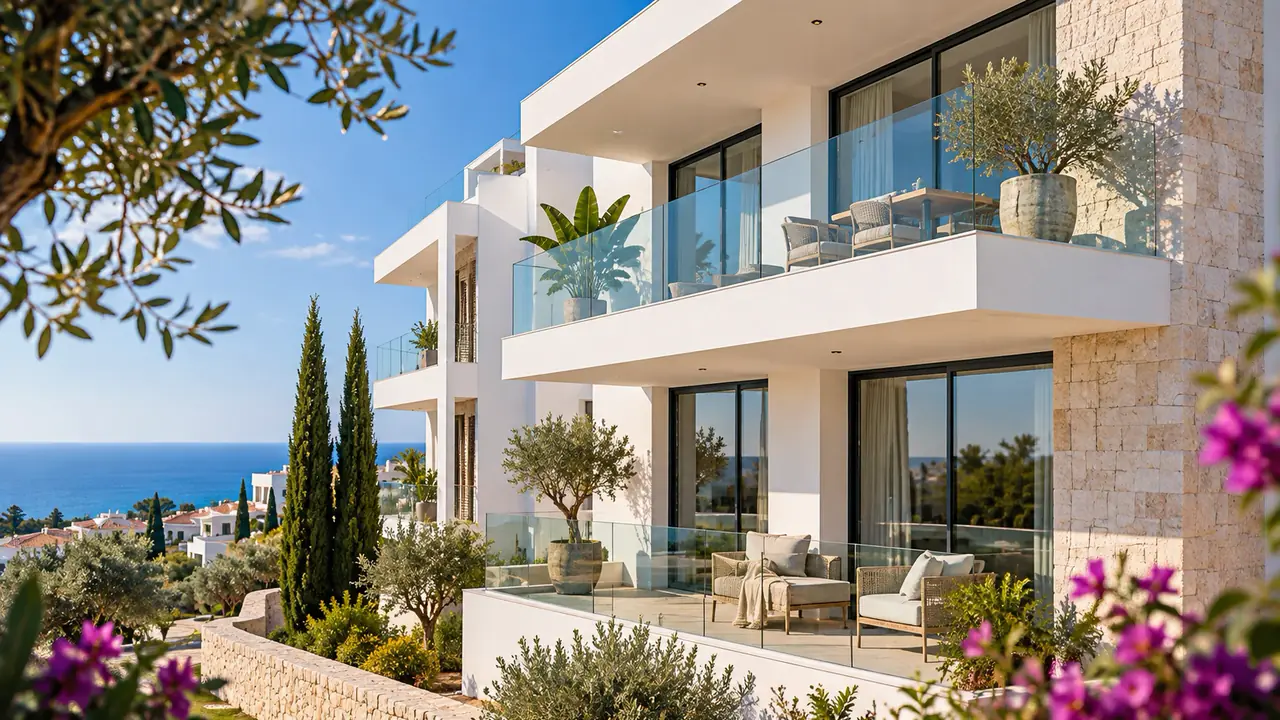
German and Cypriot construction compared
| Area | Germany | Cyprus |
|---|---|---|
| Heating | Central, with radiators or underfloor heating, gas or heat-pump based | Almost exclusively air-conditioning based with electric heating, underfloor heating rare |
| Insulation | KfW 55 or better | Class A with 12 cm of insulation corresponds to premium; class B with 6 to 8 cm corresponds to older German buildings under the first Thermal Insulation Ordinance (1. WSV) of 1978 |
| Windows | Increasingly timber-aluminium windows with triple glazing | Almost exclusively aluminium, triple glazing only for premium |
| Roof | Mostly pitched roof with clay tiles | Flat roof with tiles or gravel, use as a roof terrace is common |
| Interior fit-out | Natural materials (real wood, natural stone) more common | Porcelain stoneware dominant, wood effect instead of real wood |
| Bathroom | Mostly German ceramics manufacturers | Italian or Spanish large-format tiles, German manufacturers rare |
| Service life | 80 to 100 years with standard maintenance | 60 to 80 years for premium, 40 to 60 years for standard (greater wear because of UV and salt) |
How to assess construction quality at viewings
A ten-point check for every site or apartment viewing. Allow around two hours, take a torch with you, and have the specification list sent to you as a PDF beforehand.
- Ask to see the energy certificate: class A or B, C for older properties. Below C is critical.
- Check window joints and frame rebates: no gaps, no condensation on the inside in winter, tight rubber seals.
- Inspect tile joints: straight, of even width, no chipping.
- Taps and sanitary ware: ask for brand and year. Mid-range to premium brands are good signs.
- Check the type of air conditioning: inverter, energy class A++ or higher, branded manufacturer (Daikin, Mitsubishi, LG, Samsung).
- Bathroom waterproofing and shower area: neatly finished, no visible silicone defects or leaks.
- Circuits and sockets: adequately dimensioned, no surface-mounted installation without good reason.
- Roof and terrace: outlets clean, no open joints, fall towards the outlet.
- Façade: no cracks, no discolouration, no visible salt efflorescence.
- Air and smell in the rooms: no musty air, no visible damp patches on walls or ceilings.
The cost of premium construction quality
| Segment | Construction costs per m² |
|---|---|
| Standard new build, Paphos | approx. EUR 2,400 to 2,800 |
| Premium new build, Paphos | approx. EUR 3,200 to 4,500 |
| Premium new build, Limassol coast | EUR 4,500 to 7,500 |
| Top segment with smart home, pool, wellness, high-quality flooring | EUR 6,000 and more |
The extra cost of a premium specification pays off in two dimensions: lower running costs (40 to 60 per cent less electricity) and better value retention. A class A new build with a premium specification loses considerably less value over 10 years than a standard new build.
Summary
As a term, "luxury" says practically nothing on the Cypriot property market. Real construction quality comes from the combination of an earthquake-resistant structural shell with quality concrete and reinforcement, energy class A or better with appropriate insulation and modern glazing, high-quality materials in the fit-out (not just on the surface), inverter air conditioning with German or Japanese branded technology, and photovoltaics with solar thermal as standard rather than as an extra.
As a building environment, Cyprus is not Germany. The climate makes different demands, which have to be taken into account in the structural shell and in the materials. Anyone who wants quality in Cyprus checks specifications concretely, with brands and certificates, not buzzwords in brochures. Anyone who manages that gets a property that still delivers after 10 years what the brochure promised.
Sources and further links
- Cyprus Technical Chamber (ETEK) — technical standards and guidelines
- Cyprus Energy Agency — PV funding, net metering, energy classes
- Cyprus Ministry of Energy — EPC, Implementation Decree 119/2020
- EU Directive 2010/31 (Energy Performance of Buildings) — national transposition in Cyprus
- Eurocode 8 — earthquake-resistant construction, zoning and requirements
- Building and Construction Law — Cypriot building regulations
- EN 10080 — standards for reinforcing steel