Purchase costs in Cyprus 2026: the complete breakdown
VAT at 5 or 19 per cent, transfer fees, lawyer, abolition of stamp duty: all purchase costs in Cyprus in 2026 with four concrete worked examples.
VAT (5 or 19 per cent), transfer fees, lawyer, abolition of stamp duty: all the additional costs for 2026 with concrete worked examples. As of April 2026. All figures are based on the VAT Law N.95(I)/2000 as amended by Law 42(I)/2023, the Transfer Fees Law Cap. 219 with the 50 per cent reduction under Law 119(I)/2015, the abolition of stamp duty by Law 239(I)/2025 and the current fee schedules of the Cyprus Bar Association and the Department of Lands and Surveys. We do not provide tax advice. The specific purchase structure and input VAT deduction should be discussed with a Cypriot tax adviser.
Why purchase costs matter
The purchase price is the one figure everyone knows. The additional purchase costs are the figure that determines how much capital you actually need. This article shows you all the purchase costs in Cyprus in detail, with scales, exceptions and concrete worked examples for four typical scenarios. So that you know the real capital requirement before you pay a deposit.
The most important sentence first: depending on the case, purchase costs in Cyprus are between 4 and 23 per cent of the purchase price. The range arises almost entirely from VAT (0, 5 or 19 per cent), which applies depending on use and type of property. All the other items are manageable.

The individual items at a glance
VAT
- 0 per cent: resale properties from private individuals that have been used for at least 18 months
- 5 per cent (reduced): new build for own use as a main residence, area up to 130 m², purchase price up to EUR 350,000, total area up to 190 m², total purchase price up to EUR 475,000, 10-year holding requirement
- 19 per cent (standard): new-build investment, purchase through a company, second home, all properties above the stated limits
Mixed taxation: if the living space is between 130 and 190 m², the first 130 m² are taxed at 5 per cent and the excess at 19 per cent. The same logic applies to a purchase price between EUR 350,000 and 475,000.
Transfer fees
Progressive scale by band of the purchase price:
| Band of purchase price | Rate |
|---|---|
| Up to EUR 85,000 | 3 per cent |
| EUR 85,001 to 170,000 | 5 per cent |
| Above EUR 170,000 | 8 per cent |
Exceptions:
- New build with VAT paid: transfer fees do not apply at all
- Resale without VAT: 50 per cent statutory discount (Law 119(I)/2015)
Example: for a purchase price of EUR 300,000, the transfer fees without the discount are EUR 17,200 (3 per cent on 85,000 = EUR 2,550, plus 5 per cent on 85,000 = EUR 4,250, plus 8 per cent on 130,000 = EUR 10,400). With the 50 per cent discount, EUR 8,600. For a new build with VAT, zero.
Legal fees
- Fee: 1 to 1.5 per cent of the purchase price (in exceptional cases up to 2 per cent for very small or very complex properties)
- VAT on the fee: 19 per cent
- Specific performance registration (Law 81(I)/2011): 0.5 per cent of the purchase price, one-off at the Land Registry
- Power of attorney and ancillary services: an additional EUR 80 to 500
Realistic total legal costs for a EUR 300,000 property: EUR 5,500 to 7,500 including VAT and registration.
Stamp duty
Abolished since 1 January 2026 by Law 239(I)/2025. Older guides still quote 0.15 to 0.20 per cent. That now applies only to contracts signed up to 31 December 2025.
Other one-off costs
- Valuation and survey (for resale): EUR 400 to 800
- Connections (electricity, water, telephone, internet): EUR 500 to 1,500 one-off
- Opening a bank account: EUR 50 to 200 in fees, plus KYC documents
- Furnishing and furniture (optional): from EUR 5,000 for a simple fit-out, EUR 15,000 to 40,000 for an upmarket one
- Title deed transfer: no extra fee if VAT or transfer fees have already been paid
What does NOT exist
- Real estate transfer tax: does not exist in Cyprus; there are only transfer fees
- Notary: no mandatory notarisation as in Germany; the lawyer takes on that function
- Estate agent's commission for buyers: traditionally borne by the seller or developer; the buyer generally pays nothing
- Stamp duty: abolished since 2026
- Annual property tax: abolished since 2017
Compact cost table by scenario
| Scenario | VAT | Transfer fees | Lawyer and registration |
|---|---|---|---|
| A: New build for own use, area up to 130 m² | 5 per cent | none | 1 to 1.5 per cent plus 19 per cent VAT, 0.5 per cent registration |
| B: New build for own use, area 130 to 190 m² | Mixed taxation, 5 to 19 per cent pro rata | none | same |
| C: New-build investment (private or Ltd.) | 19 per cent (partly recoverable as input VAT) | none | same |
| D: Resale property older than 18 months | none | 50 per cent discount on the 3/5/8 scale | same, plus a renovation reserve where applicable |
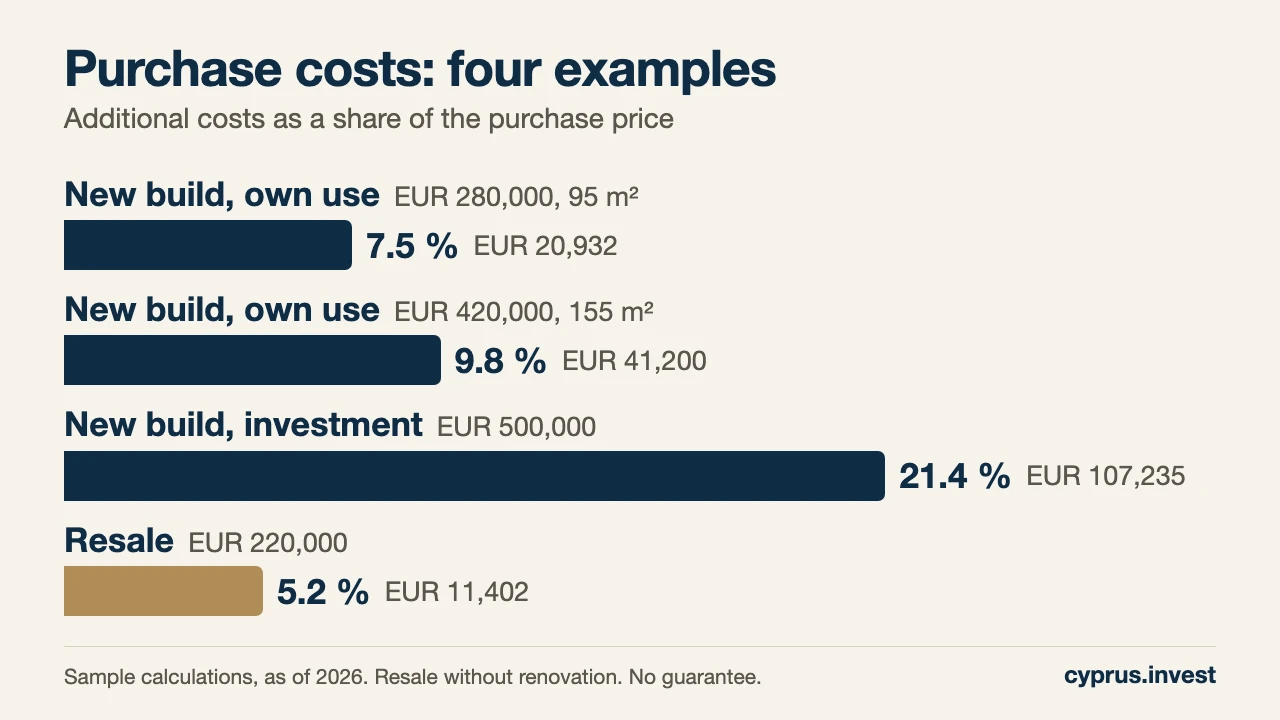
Worked example 1: New build for own use, EUR 280,000, 95 m²
A typical scenario for a winter resident or expat with an apartment in Paphos or Larnaca.
- Purchase price: EUR 280,000
- VAT at 5 per cent (own use, area under 130 m², price under EUR 350,000): EUR 14,000
- Transfer fees: EUR 0 (new build with VAT)
- Lawyer at 1.3 per cent plus 19 per cent VAT: EUR 4,332
- Specific performance registration at 0.5 per cent: EUR 1,400
- Connections, sundries: EUR 1,200
- Stamp duty: EUR 0
- Total purchase costs: EUR 20,932
- Total capital required: EUR 300,932
- Purchase costs as a share of the price: 7.5 per cent
Worked example 2: New build for own use, EUR 420,000, 155 m²
A larger apartment or small villa in Paphos or Pegeia. Mixed taxation for VAT, because area and price are in the middle band.
- Purchase price: EUR 420,000
- VAT with mixed taxation: 5 per cent on EUR 350,000 = EUR 17,500, 19 per cent on the remaining EUR 70,000 = EUR 13,300, total EUR 30,800 (the EUR 350,000 price limit bites harder here than the 130 m² area limit)
- Transfer fees: EUR 0 (new build with VAT)
- Lawyer at 1.3 per cent plus 19 per cent VAT: EUR 6,500
- Specific performance registration at 0.5 per cent: EUR 2,100
- Connections, sundries: EUR 1,800
- Stamp duty: EUR 0
- Total purchase costs: EUR 41,200
- Total capital required: EUR 461,200
- Purchase costs as a share of the price: 9.8 per cent
Note: anyone who buys above the limits (190 m² or EUR 475,000) loses the reduced rate entirely and pays 19 per cent on the whole purchase price. That can make a difference of EUR 30,000 and more. For properties close to the limit, a precise measurement of the area and, where appropriate, renegotiation are worthwhile.
Worked example 3: New-build investment, EUR 500,000
An apartment in Limassol or Paphos for letting, bought by a natural person. For Ltd. structures, slightly different values apply to the input VAT deduction.
- Purchase price: EUR 500,000
- VAT at 19 per cent (investment): EUR 95,000
- Transfer fees: EUR 0 (new build with VAT)
- Lawyer at 1.3 per cent plus 19 per cent VAT: EUR 7,735
- Specific performance registration at 0.5 per cent: EUR 2,500
- Connections, sundries: EUR 2,000
- Stamp duty: EUR 0
- Total purchase costs: EUR 107,235
- Total capital required: EUR 607,235
- Purchase costs as a share of the price: 21.4 per cent
If the property is let through a Cypriot Ltd. with an active business, part of the VAT can be recovered as input VAT. This does not happen automatically and requires clean bookkeeping and tax advice. As a rough calculation, where the use carries a full right to deduct input VAT, purchase costs fall to around 5 to 7 per cent of the price, plus corporation tax on the profit. Details of the tax structures can be found in the tax guide and in the letting guide.
Worked example 4: Resale property, EUR 220,000
Resale of a second-hand property in Larnaca or Nicosia. No VAT, but transfer fees with the 50 per cent discount.
- Purchase price: EUR 220,000
- VAT: EUR 0 (resale property older than 18 months)
- Transfer fees gross (3 per cent on 85,000 = EUR 2,550, plus 5 per cent on 85,000 = EUR 4,250, plus 8 per cent on 50,000 = EUR 4,000): EUR 10,800
- Transfer fees effective (50 per cent discount): EUR 5,400
- Lawyer at 1.3 per cent plus 19 per cent VAT: EUR 3,402
- Specific performance registration at 0.5 per cent: EUR 1,100
- Survey: EUR 500
- Connections, sundries: EUR 1,000
- Stamp duty: EUR 0
- Total purchase costs excluding renovation: EUR 11,402
- Purchase costs as a share of the price, excluding renovation: 5.2 per cent
Caution: for resale properties the purchase costs themselves are low, but a renovation reserve of 10 to 15 per cent of the purchase price often has to be added. Older Cypriot houses (pre-2010) often have poor energy performance, poor insulation and older building services. The supposed saving on the purchase price can evaporate within 12 to 24 months. Details in the construction quality guide.
Who pays what: buyer and seller
The division of roles for purchase costs differs from that in Germany:
- Buyer pays: VAT, transfer fees, own lawyer, specific performance registration, connections, survey
- Seller pays: own lawyer, capital gains tax (20 per cent flat, with allowances), estate agent's commission where applicable, early repayment charge on a mortgage
- Estate agent: traditionally paid by the seller or developer, not by the buyer
The seller's capital gains tax is relevant to you if you want to sell later. Allowance: EUR 150,000 for own use, EUR 30,000 for investment. Gains above that are taxed at 20 per cent. The allowance is a lifetime allowance, not per property.
Cost comparison with the DACH region and Mallorca
| Market | Purchase costs as a share of the price |
|---|---|
| Cyprus, new build for own use | 7 to 10 per cent |
| Cyprus, new-build investment | 21 to 23 per cent (can be partly reduced via input VAT) |
| Cyprus, resale | 4 to 7 per cent |
| Germany | 10 to 15 per cent (real estate transfer tax 3.5 to 6.5 per cent, notary and land register 1.5 to 2 per cent, estate agent 3.57 to 7.14 per cent) |
| Austria | 9 to 12 per cent (real estate transfer tax 3.5 per cent, registration 1.1 per cent, lawyer 1 to 3 per cent, estate agent up to 3 per cent) |
| Mallorca | 11 to 15 per cent (ITP or IVA 8 to 13 per cent, AJD 1.5 per cent, notary 1 to 1.5 per cent, lawyer 1 to 1.5 per cent) |
Owner-occupiers save around 3 to 7 percentage points when buying in Cyprus compared with the DACH region. Investment buyers are at a comparable level, with structuring options via a Cypriot Ltd. to optimise input VAT.
What you should avoid
- Taking net prices as your yardstick: Brochures frequently show the purchase price excluding VAT ("from EUR 380,000 net"). For an investment, 19 per cent comes on top, which is an additional EUR 72,200. Always calculate gross.
- Underestimating the area and price limits of the 5 per cent rule: A property with 132 m² of living space does not fall out of the scheme, but pays the mixed-taxed portion. A property with 195 m² loses the reduced rate entirely.
- Negotiating the lawyer's fee too late: The fee is often put on the table after signature, not before. Ask for a written agreement with a precise breakdown before you instruct the lawyer.
- Not insisting on specific performance registration: Without this registration, your claims to transfer of the title deed are merely contractual claims against the developer. Cost: 0.5 per cent. Benefit: large.
- Overestimating the input VAT deduction for a Ltd.: Recovering the 19 per cent VAT as input VAT only works with active letting that generates turnover subject to VAT (short-term letting) and clean bookkeeping. With long-term letting without a VAT option it is often not possible.
Summary
Cyprus is one of the cheapest EU countries to buy in if you are an owner-occupier or a buyer of resale property. For owner-occupiers, thanks to 5 per cent VAT, no transfer fees and the abolition of stamp duty, purchase costs regularly come in under 10 per cent of the purchase price. For resale properties, 4 to 7 per cent is enough. Investment buyers pay 21 to 23 per cent including VAT, but can recover part of it with a professional Ltd. structure.
The most important lever is the choice of VAT rate. A sound assessment of whether you really will use the property yourself for 10 years or want to let it later decides a difference of up to EUR 42,000 on a EUR 300,000 property. Anyone who plans honestly pays the right rate just once.
Sources and further links
- Cyprus Tax Department — VAT Law N.95(I)/2000, Law 42(I)/2023 (VAT reform for new builds)
- Law 239(I)/2025 — abolition of stamp duty, full text
- Law 119(I)/2015 — 50 per cent discount on transfer fees for resale properties
- Transfer Fees Law Cap. 219 — scale of transfer fees
- Sale of Immovable Property (Specific Performance) Law N.81(I)/2011 — registration of the contract of sale
- Cyprus Department of Lands and Surveys — calculation of transfer fees, title deed transfer
- Cyprus Bar Association — current fee schedules